XI’AN, SHAANXI, CHINA, August 12, 2026 /EINPresswire.com/ — When supplement, functional food, and formulation teams line up active-ingredient content, batch documentation, and finished-formula performance on a single sourcing checklist, the phrase Standardized Curcumin Extract Manufacturer stops describing where a raw material comes from and starts describing a discipline: how specification, testing, and delivery logic hold together. Standardization answers whether the active content is clearly defined and repeatable. High dissolution points further downstream, toward how a formula disperses, delivers, and is absorbed. The two questions are related, yet they are not the same, and blurring them into a single promise helps no one on the buying side.
Xi’an Demeter Biotech Co., Ltd. builds from a curcumin portfolio that includes curcumin at 10%-95%, water-soluble curcumin at 10%-20%, water-soluble curcumin colors from E40 to E160, oil-soluble curcumin colors from E40 to E100, turmeric color powder at 1%-5%, and feed-grade options. This portfolio gives a project a verifiable way to match active content, solubility, color strength, and end use instead of stretching one specification across every application. For each quotation, the selected grade should be named exactly so a color number or solubility form is not mistaken for active content. For a purchasing lead comparing suppliers, the useful question is which supplier can show the specification, paperwork, and application logic behind each grade. DUPHAT 2026 will take place from August 25 to 27, 2026 at Dubai World Trade Centre, where Xi’an Demeter Biotech Co., Ltd. is listed as an exhibitor at Stand 2G16. Demeterherb will promote its Curcumin portfolio to buyers evaluating specification, solubility, and formulation fit.
Why Does Standardized Curcumin Matter Before Dissolution Is Considered?
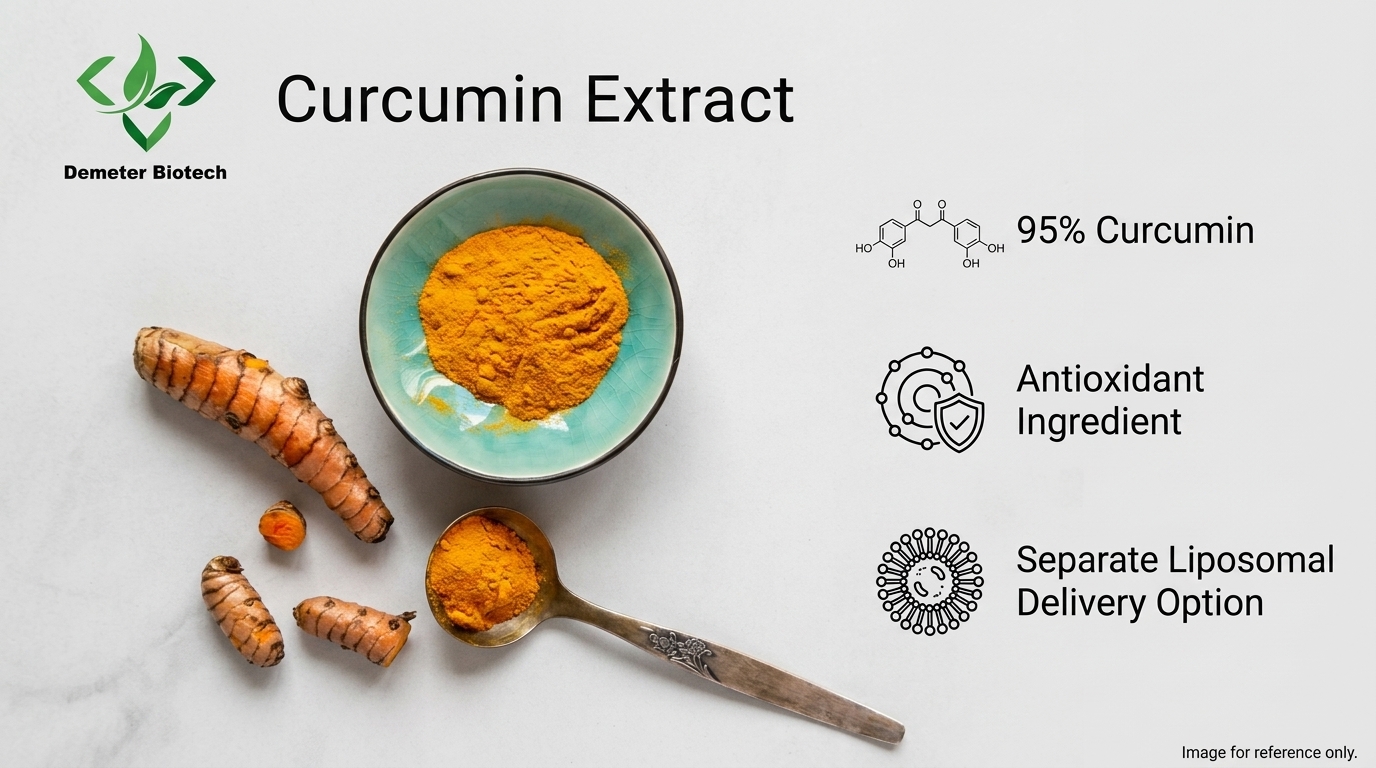
Standardization is less about buying “turmeric extract” as a name and more about locking the active ingredient, the specification range, the test method, and document availability before anything else is decided. On the company’s turmeric extract page, the material is defined by root as the part used, an orange-yellow powder appearance, curcumin as the active ingredient, a 10%-95% specification range, and HPLC as the test method. Taken together, those elements give a formulation conversation a fixed starting point rather than letting a product name stand in for a real specification. A COA is available for each order, and the powder carries a 24-month shelf life, so sourcing and quality teams have clear reference points from the first inquiry. This is the practical difference a standardized curcumin extract manufacturer makes: the numbers are defined before the negotiation starts, and every figure can be traced back to a page or a document rather than a sales adjective.
What Do High Dissolution Demands Change in a Curcumin Project?
High dissolution is not the same thing as simply raising curcumin content. A project team must first decide whether it needs conventional curcumin, a water-soluble grade for easier dispersion, an oil-soluble color grade, or a turmeric color powder for a defined color-strength target. Demeterherb’s water-soluble curcumin at 10%-20% and water-soluble color grades from E40 to E160 give formulators a route for water-based systems. Oil-soluble color grades from E40 to E100 serve oil-phase applications. A beverage or water-based formula may prioritize the water-soluble route, while oil-based foods or color systems may require oil-soluble grades. Feed projects should be quoted separately. These are distinct material choices that should be validated in the finished formulation rather than presented as a universal absorption guarantee.
How Do Curcumin Specifications Support Formulation-Ready Sourcing?
Curcumin specifications support formulation-ready sourcing when active content, solubility, color strength, and end use are stated separately. Conventional curcumin is available from 10% to 95%; water-soluble curcumin is available at 10%-20%; water-soluble color grades cover E40-E160; oil-soluble color grades cover E40-E100; and turmeric color powder covers 1%-5%, with feed-grade options also available. Procurement teams can then match the material to nutrition supplement, food, color, or feed applications before confirming COA, packaging, and trial quantities. This separation reduces sample mismatch, prevents color-grade codes from being read as assay percentages, and gives quality teams a cleaner path to compare COAs. Packaging remains available in 1 kg foil bags or 25 kg cartons and fiber drums, so a small trial can move into bulk supply without changing the basic packing path.
How Does ISO22000 Create a Repeatable Quality Framework?
ISO22000 does not replace batch testing or formula validation. It places food-safety controls inside a consistent management framework that runs from production through service. For a standardized botanical extract, that framework should sit beside the specification, test method, COA, and each customer’s project requirements. Xi’an Demeter Biotech Co., Ltd. lists ISO22000 alongside complete quality-control measures and company-level EU Organic, USDA Organic, FDA, and Halal, Kosher credentials, with production held to the national GMP standard. Each curcumin grade still requires its own specification and order documents.
Why Can Demeterherb Bridge Standardized Supply and Application-Specific Solubility?
Demeterherb places conventional curcumin, water-soluble grades, oil-soluble color grades, turmeric color powder, and feed-grade options inside one supply system. Conventional curcumin answers the question of active content, while water-soluble and oil-soluble grades address different formulation environments. Turmeric color powder provides a separate color-strength route. Keeping these choices distinct prevents one grade’s performance language from being generalized across the full portfolio. It also allows OEM and ODM discussions to begin from the exact curcumin grade rather than from a generic product name. With products reaching more than 50 countries and regions and OEM options spanning hard capsules, soft capsules, tablets, granules, and private-label packaging, the supplier relationship can extend from raw material to customized supply.
A Clear Line Between Content and Delivery
The sourcing value of standardized curcumin rests on an identifiable active ingredient, a defined specification range, HPLC testing, and COA documentation. High dissolution should be linked to a concrete water-soluble or oil-soluble grade and validated in the target formulation. This separation keeps material specification, application, and technical claim aligned across a program. It is the standard a standardized curcumin extract manufacturer should be measured against.
Projects can compare curcumin at 10%-95%, water-soluble curcumin at 10%-20%, water-soluble color grades at E40-E160, oil-soluble color grades at E40-E100, turmeric color powder at 1%-5%, and feed-grade options.
Buyers can also review ISO22000-backed quality documentation and customized packaging at https://www.demeterherb.com/. The company’s guiding philosophy stays simple: customer-focused, employees-fundamental, and quality-oriented.
Xi’an Demeter Biotech Co., Ltd.
Demeterherb
email us here
Visit us on social media:
LinkedIn
Facebook
X
Legal Disclaimer:
EIN Presswire provides this news content “as is” without warranty of any kind. We do not accept any responsibility or liability
for the accuracy, content, images, videos, licenses, completeness, legality, or reliability of the information contained in this
article. If you have any complaints or copyright issues related to this article, kindly contact the author above.

Media gallery