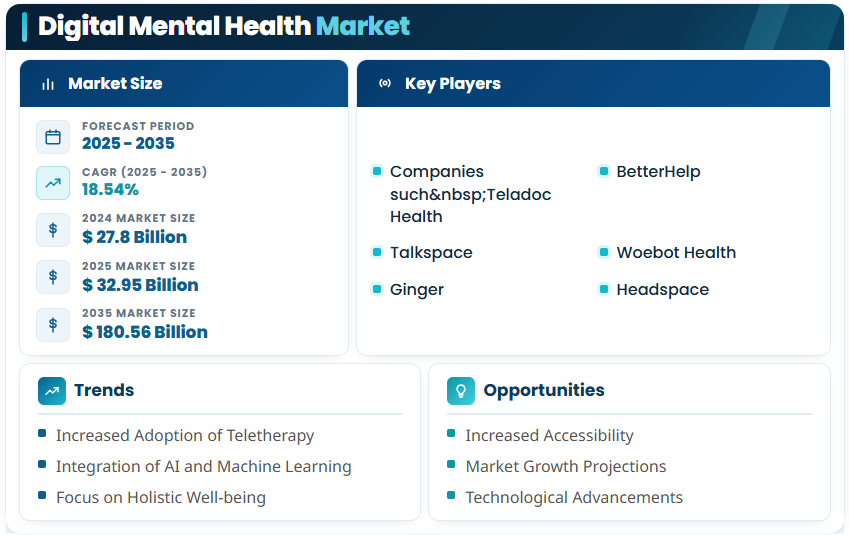
Digital Mental Health Market to Surge from USD 32.95 Billion in 2025 to USD 180.56 Billion by 2035-By Telehealth Normalization, AI-Driven Personalization
NY, CA, UNITED STATES, August 21, 2026 /EINPresswire.com/ — As per Market Research Future, the global Digital Mental Health Market size is projected to reach USD 180.56 Billion by 2035 from USD 32.95 Billion in 2025, at a CAGR of 18.54% during the forecast period 2025–2035. The market base was estimated at USD 27.8 Billion in 2024.
The 18.54% CAGR—anchored by structural shifts in care delivery and technological innovation—is propelled by three converging forces: the normalization of digital mental health via telehealth platforms and mobile applications, which have transitioned therapy from clinic-gated appointments into on-demand, accessible care; the rapid integration of artificial intelligence and machine learning into therapeutic workflows, enabling predictive analytics, personalized intervention matching, and real-time mood monitoring that improve engagement and clinical outcomes; and the expanding integration of mental health benefits into corporate wellness programs and payer coverage models, which has scaled employer-sponsored access and reduced out-of-pocket barriers for working-age adults.
Regulatory and investment dynamics are amplifying this momentum. Telehealth availability among U.S. mental health treatment facilities rose from under 40% in 2019 to nearly 90% by 2022, and by 2024, 40% of adults experiencing serious psychological distress reported using a digital health tool—up from just 10% in 2013. According to the WHO, over 970 million people were living with mental disorders globally in 2019, while depression affected more than 280 million individuals. More than 60% of countries implementing digital health strategies are strengthening infrastructure and expanding global access to mental healthcare solutions. These forces are creating the clinical infrastructure and consumer confidence on which the Digital Mental Health Market depends.
Request A Free Sample:
https://www.marketresearchfuture.com/sample_request/11062
Key Market Trends & Growth Drivers
Telehealth Normalization and Platform Accessibility
The Digital Mental Health Market has been fundamentally reshaped by the mass adoption of teletherapy and virtual care platforms. Telehealth utilization increased by over 154% during the early pandemic phases, and sustained demand has kept remote mental health services at the forefront of care delivery. Teletherapy commands the largest platform share at approximately 46%, offering personalized therapeutic experiences through virtual sessions favored for convenience and efficacy. Mobile applications, while currently smaller in market share, are rapidly gaining traction—particularly among younger demographics—and are projected to grow from USD 10.0 Billion in 2024 to USD 70.0 Billion by 2035. This widespread platform proliferation has transitioned mental health support from traditional in-person appointments into accessible, on-demand transactions, stabilizing engagement rates across the sector.
AI-Driven Personalization and Predictive Analytics
The incorporation of artificial intelligence and machine learning technologies is emerging as a pivotal trend within the Digital Mental Health Market. AI dominates the technology segment with an estimated 44% share, facilitating personalized mental health support and predictive analytics that significantly enhance user experience and engagement. The AI segment is expected to grow from USD 5.0 Billion in 2024 to USD 35.0 Billion by 2035. Machine-learning models analyze user data to provide tailored recommendations for mental health interventions, improving early diagnosis and personalized treatment plans across millions of users globally. Platforms leveraging AI-driven chatbots and analytics-driven tools report improved client retention and satisfaction, with continuous support models bridging gaps between live therapy sessions.
Corporate Wellness Integration and Payer Expansion
Employers and payers are emerging as critical scaling vectors for the Digital Mental Health Market. Healthcare providers are adopting digital solutions to enhance patient care, streamline processes, and improve therapeutic outreach—the provider segment led with a valuation of USD 9.12 Billion in 2024, expected to rise to USD 60.12 Billion by 2035. Subscription services dominate the revenue model with a 61% share, providing ongoing support and continuous content delivery that yields sticky consumer engagement. Corporate wellness programs across Fortune 500 companies and mid-market employers are increasingly subsidizing digital mental health access, while payer coverage expansion is reducing out-of-pocket friction for plan members. This B2B and B2B2C channel expansion represents a durable growth vector distinct from direct-to-consumer acquisition.
Holistic Well-being and Primary Care Integration
There is a growing emphasis on holistic well-being within the Digital Mental Health Market, reflecting a shift toward integrating mental health with physical health. More than 70% of countries in the Americas are integrating mental health into primary care systems, and digital tools are streamlining this convergence. Integrated health programs across more than 100 countries are increasingly combining mental and physical care, supporting holistic digital health platforms. Digital solutions that address both mental and physical health concerns are gaining popularity as individuals seek comprehensive approaches to their well-being, creating new product categories that blend behavioral health with chronic disease management and lifestyle coaching.
Ask for Customization:
https://www.marketresearchfuture.com/ask_for_customize/11062
Market Segment Insights
BY COMPONENT
Software: Dominant segment encompassing cloud-based and web-based platforms, sustained by scalable infrastructure and recurring SaaS revenue models. Software solutions anchor the technology stack, enabling seamless connectivity, data analytics, and remote therapeutic delivery.
Services: Second-largest segment encompassing Cognitive Behavioral Therapy (CBT), Acceptance and Commitment Therapy (ACT), and other evidence-based therapeutic interventions delivered through digital channels. Services benefit from licensed practitioner networks and protocol standardization that drive clinical credibility and payer reimbursement.
BY DISORDER TYPE
Mental Disorder: Largest disorder category including anxiety disorder, post-traumatic stress, substance abuse disorder, schizophrenia, and other conditions. Anxiety and depression-related indications represent the highest-volume addressable populations, driven by rising prevalence and growing help-seeking behavior.
Behavioral Disorder: Fastest-growing disorder category including attention deficit hyperactivity disorder (ADHD), emotional behavioral disorder, oppositional defiant disorder, obsessive compulsive disorder (OCD), and other conditions. Pediatric and adolescent behavioral health demand is accelerating as schools and parents seek non-pharmacological intervention pathways.
BY AGE GROUP
Adult (20 to 65): Dominant age segment reflecting the working-age population’s exposure to occupational stress, economic uncertainty, and caregiver burden. This cohort drives the majority of employer-sponsored and direct-to-consumer subscription volume.
Children & Adolescents (10 to 19): Fastest-growing age segment, with over 13% of adolescents globally living with diagnosed mental health conditions. School-based partnerships—such as the Baltimore County Public Schools collaboration with Talkspace providing free telehealth therapy to over 32,000 high school students—are scaling access and normalizing early intervention.
Geriatric (Above 65): Emerging segment driven by aging demographics, social isolation, and comorbid chronic conditions. Digital literacy barriers are moderating adoption, though simplified interfaces and caregiver-mediated access are improving penetration.
BY END USER
Patients: Dominant end-user segment with an estimated 68% share, driven by direct-to-consumer app adoption, teletherapy subscriptions, and self-help program utilization. Individuals leverage digital platforms to access therapeutic resources conveniently and flexibly, outside traditional clinical schedules.
Providers: Fastest-growing end-user segment, with healthcare institutions, clinics, and individual practitioners adopting digital solutions to enhance patient care, streamline documentation, and extend therapeutic reach beyond physical practice boundaries. Provider-facing platforms integrate electronic health records, billing systems, and outcome measurement tools.
Payers: Strategic end-user segment including insurance providers, employers, and government programs that underwrite digital mental health benefits. Payer adoption is accelerating as health-economic data demonstrates cost offsets against emergency department utilization and inpatient psychiatric admissions.
Read Detailed Insights:
https://www.marketresearchfuture.com/reports/digital-mental-health-market-11062
Regional Outlook
North America — Dominant Market (~42.19% Share, 2025)
North America leads the Digital Mental Health Market, accounting for over 42.19% of global revenue in 2025 and generating approximately USD 13.9 Billion. The region’s dominance is driven by high mental health awareness, advanced telehealth infrastructure, supportive regulatory frameworks, and significant venture investment. According to the CDC, over 20% of U.S. adults experience mental illness annually, while telehealth usage increased by more than 150% during recent years. The competitive landscape is dominated by key players such as Teladoc Health, BetterHelp, and Talkspace, which are leveraging technology to enhance user experience and scale provider networks.
Europe — Second Largest (23.67% Share, 2025)
Europe reached USD 7.8 billion in 2025, making it the second-largest regional market. Growth is driven by increasing government initiatives aimed at mental health improvement and the integration of digital solutions into traditional healthcare systems. The European Centre for Disease Prevention and Control (ECDC) highlights that over 84 million people in Europe are affected by mental health conditions, while more than 50% of EU countries have implemented national digital health strategies. Leading countries like Germany and the UK are at the forefront, with a growing number of startups and established players like SilverCloud Health and MyTherapy expanding across member states.
Asia-Pacific — Fastest-Growing Region (Emerging Potential)
The Asia-Pacific region is witnessing burgeoning Digital Mental Health market potential, projected to reach significant scale by 2035. Factors such as increasing smartphone penetration, rising awareness of mental health issues, and government initiatives to promote mental well-being are driving growth. Countries like Australia and Japan are leading the charge, with a growing number of digital platforms catering to mental health needs. International players such as Woebot Health and Ginger are expanding their reach, while local startups address culturally specific therapeutic needs. The region’s diverse population and varying levels of access to traditional mental health services create unique opportunities for digital-first solutions.
Middle East & Africa — Emerging Opportunity
The Middle East and Africa region is in the early stages of developing its Digital Mental Health market, with a projected size of USD 1.3 Billion by 2025. Growth is driven by increasing awareness of mental health issues and the need for accessible care solutions. Government initiatives aimed at improving mental health services are playing a crucial role in fostering market development. Countries like South Africa and the UAE are beginning to embrace digital mental health solutions, with a growing number of startups entering the space. As the region continues to recognize the importance of mental health, the market is expected to grow, presenting opportunities for innovation and investment.
Competitive Landscape and Recent Developments
The Digital Mental Health Market exhibits moderate fragmentation, with the top players holding significant but not dominant shares. The market is characterized by a dynamic competitive landscape driven by increasing demand for accessible mental health solutions and the integration of technology in healthcare. Companies are increasingly localizing their services to cater to diverse cultural and regulatory environments, which enhances their competitive edge. Strategic alliances, AI integration, and subscription-model innovation are becoming pivotal as companies shift from price-based competition to a focus on technological differentiation and supply-chain reliability.
KEY COMPANIES AND RECENT MILESTONES
Teladoc Health (US): Category leader in telehealth and virtual care, offering comprehensive mental health services through its integrated platform. In November 2025, Teladoc Health announced a strategic partnership with a leading AI firm to enhance its teletherapy services, integrating advanced AI algorithms to improve patient outcomes through personalized treatment plans.
BetterHelp (US): Leading direct-to-consumer online therapy platform emphasizing user experience and accessibility. In October 2025, BetterHelp launched a new initiative aimed at increasing accessibility for underserved communities by offering subsidized therapy sessions, broadening market reach and aligning with industry emphasis on social responsibility.
Talkspace (US): Pioneer in subscription-based online therapy and psychiatric services. In September 2025, Talkspace introduced a subscription model incorporating AI-driven chatbots to provide users with immediate support between therapy sessions, enhancing user engagement and reflecting broader industry trends toward continuous care. In December 2023, Talkspace partnered with Evernow to provide enhanced mental health services to women navigating perimenopause and menopause, and separately partnered with Baltimore County Public Schools to provide free, unlimited telehealth therapy to over 32,000 high school students.
Woebot Health (US): AI-native mental health platform delivering cognitive behavioral therapy through conversational agents. Differentiated by its clinically validated chatbot approach and emphasis on scalable, always-available mental health support.
Ginger (US): On-demand mental health platform offering text-based coaching, video therapy, and psychiatry. Focused on employer and health plan partnerships, Ginger provides integrated care navigation that bridges coaching and clinical services.
Headspace (US): Global leader in mindfulness and meditation applications, expanding into clinical-grade mental health services through Headspace Health. Leverages a massive consumer user base to funnel engagement into higher-acuity therapeutic offerings.
Calm (US): Premier sleep and meditation application with enterprise wellness partnerships. Focused on stress reduction, sleep improvement, and content-led mental wellness rather than clinical therapy.
SilverCloud Health (IE): European leader in digital mental health platforms, offering internet-based cognitive behavioral therapy (iCBT) programs. Strong presence in NHS partnerships and payer-funded mental health pathways across the UK and continental Europe.
MyTherapy (DE): Digital health platform focused on medication management and therapy adherence, with expanding mental health module integration. Strong in European pharmacy-channel distribution and chronic disease management adjacencies.
Lemonaid Health (US): Telehealth platform providing mental health medication management and therapy services with a focus on accessibility and affordability. Direct-to-consumer model emphasizes rapid onboarding and transparent pricing.
Recent Industry Developments:
Teladoc Health (November 2025): Announced a strategic partnership with a leading AI firm to enhance its teletherapy services, integrating advanced AI algorithms into their platform to improve patient outcomes through personalized treatment plans.
BetterHelp (October 2025): Launched a new initiative aimed at increasing accessibility for underserved communities by offering subsidized therapy sessions, broadening market reach and strengthening brand loyalty.
Talkspace (September 2025): Introduced a subscription model incorporating AI-driven chatbots to provide users with immediate support between therapy sessions, enhancing user engagement and continuous care delivery.
Talkspace & Evernow (December 2023): Evernow, the digital care platform for women in perimenopause and menopause, partnered with Talkspace to provide enhanced mental health services and resources to women aged 40 and above navigating this pivotal life stage.
Talkspace & Baltimore County Public Schools (December 2023): Baltimore County Public Schools announced a partnership with Talkspace to provide free, unlimited telehealth therapy for all BCPS high school students ages 13 and above, giving more than 32,000 students access to high-quality messaging therapy and evidence-based mental health resources.
Smartbox Holdings (November 2021): A subsidiary of Caretech (UK) acquired REHAVISTA and LogBUK for €10 million, expanding its digital health and assistive technology portfolio.
More Related Research Insights:
https://www.marketresearchfuture.com/reports/vaccine-research-market-27935
https://www.marketresearchfuture.com/reports/influenza-vaccination-market-1621
https://www.marketresearchfuture.com/reports/pediatric-vaccines-market-5779
https://www.marketresearchfuture.com/reports/human-vaccines-market-2671
https://www.marketresearchfuture.com/reports/recombinant-vaccines-market-6130
https://www.marketresearchfuture.com/reports/immunotherapy-drugs-market-7399
https://www.marketresearchfuture.com/reports/infectious-disease-treatments-market-1626
https://www.marketresearchfuture.com/reports/biopharmaceuticals-market-8439
Larry Wilson
WantStats Research And Media Pvt. Ltd.
+1 855-661-4441
email us here
Visit us on social media:
LinkedIn
Facebook
YouTube
X
Legal Disclaimer:
EIN Presswire provides this news content “as is” without warranty of any kind. We do not accept any responsibility or liability
for the accuracy, content, images, videos, licenses, completeness, legality, or reliability of the information contained in this
article. If you have any complaints or copyright issues related to this article, kindly contact the author above.

Media gallery