
The Princeton Review’s “Paying for College: 2027 Edition” Is Out
PR Newswire
NEW YORK, Sept. 22, 2026
Annually updated guide provides strategies for completing the 2027–2028 FAFSA and CSS Profile to one’s best advantage as well as planning for college costs
NEW YORK, Sept. 22, 2026 /PRNewswire/ — The Princeton Review®, a provider of education services and college admission resources since 1981, today released the 35th edition of its annual guide to getting funding to pay for college.
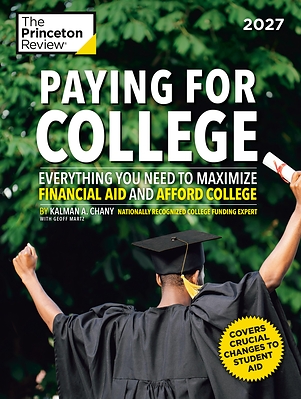
Paying for College: Everything You Need to Maximize Financial Aid and Afford College (2027 Edition, Penguin Random House, September 22, 2026, $25.99) is authored by Kalman A. Chany, a nationally recognized expert on college funding, with Geoff Martz. Chany is founder and president of Campus Consultants Inc., an independent college financial aid advisory firm based in New York City.
When Paying for College debuted in 1992, it was a one-of-a-kind resource in the category of personal finance guides. It provided detailed line-by-line guidance on strategically completing the two most important financial aid application forms for the upcoming aid application year, and it was the only book to do so.
Paying for College remains the only resource offering such targeted guidance for submitting those two crucial forms. They are the U.S. Department of Education’s FAFSA® (Free Application for Federal Student Aid), which all financial aid applicants must submit, and the College Board’s CSS Profile®, an application that hundreds of selective colleges require (and which has as many as 200 questions).
“You might think that families who receive the most financial aid would be the families with the most need,” Chany says in the introduction of the book. “In fact, this is not necessarily true. The people who receive the most aid are the people who best understand the aid process.”
Chany well understands the process. Since 1981, he has annually analyzed the major aid application forms as well as the formulas by which federal and institutional financial aid administrators assess an applicant’s need for aid based on answers on the forms. He guides his clients (and readers of this book) on how to maximize their eligibility for financial aid much in the same way an accountant advises clients on submitting their IRS returns to their best advantage. (All the strategies Chany recommends follow the law to the letter.)
In Paying for College, Chany also covers other subjects important to aid applicants and parents, including how to:
- explore long- and short-term strategies for reducing college costs
- research colleges with financial aid in mind
- compare financial aid offers and, if necessary, appeal for more aid
- obtain education loans, understand payment plans, and manage loan debt
A Special Topics chapter in the book gives particular advice on aid applications for parents who are single, separated, divorced or in blended families as well as advice for students who are independent, international or older than the traditional applicant.
The 2027 edition of Paying for College also reports on tectonic changes that have impacted the college funding landscape as a result of various provisions in the One Big Beautiful Bill Act (OBBBA) signed into law in July 2025. Chany discusses what parents and students need to know about these changes. Icons in the margins flag topics that were pending as the book went to press that readers are advised to check.
Some provisions of the OBBBA that impact federal student aid are still unresolved. “Unfortunately,” Chany notes, “some guidance involving federal education loans issued by the U.S. Department of Education is being misinterpreted—even by college aid professionals.”
Over the years, Paying for College has been praised by reviewers and finance professionals alike. Forbes contributor John Wasik noted it “can save thousands in college bills.” Washington Post syndicated columnist Michelle Singletary chose it for her Color of Money book club. Newsday Family Finance columnist Lynn Brenner recommended it as “a first-rate guide through the financial aid maze.”
Said Rob Franek, Editor-in-Chief of The Princeton Review, “Our company has a deep appreciation for the concerns of students and parents about paying for college. Among nearly 10,000 college applicants and parents of applicants who completed our 2026 College Hopes & Worries Survey in February, 93% reported they would need financial aid to pay for college, and 81% of that cohort characterized their level of need as “very” or “extremely” necessary. We hope the advice in this new edition of Paying for College will help parents and students apply strategies to get all the financial aid they are entitled to and enable them to pay less for college.”
Paying for College is one of more than 150 books developed by The Princeton Review and published by Penguin Random House in a line that includes The Best 392 Colleges and guides to the SAT®, ACT®, and AP® exams. The Princeton Review is also known for its annual college rankings in dozens of categories including its popular “Great Financial Aid” college ranking list and its “Best Value Colleges” lists.
About Kalman A. Chany
Kalman A. Chany is the founder and president of Campus Consultants Inc., an independent New York City-based financial aid advisory firm. For more than four decades, his firm has helped thousands of families maximize their financial aid eligibility and save tens of thousands of dollars off the cost of their children’s college education. Kal has been sourced in The Wall Street Journal, on CNBC, and in Money magazine, and he has appeared on CBS Evening News, NBC Nightly News, and other broadcast media.
About The Princeton Review
The Princeton Review is a leading tutoring, test prep, and college admissions services company. Every year, it helps millions of college- and graduate school–bound students as well as working professionals achieve their education and career goals through its many education services and products. These include online and in-person courses delivered by a network of more than 4,000 teachers and tutors; online resources; a line of more than 150 print and digital books published by Penguin Random House; and dozens of categories of school rankings. Founded in 1981, the company is now in its 45th year. The company’s Tutor.com brand, now in its 25th year, is one of the largest online tutoring services in the U.S. It comprises a community of thousands of tutors who have delivered more than 29 million tutoring sessions. The Princeton Review, headquartered in New York, NY, is not affiliated with Princeton University. For more information, visit PrincetonReview.com. Follow the company on Facebook (@ThePrincetonReviewSAT), Instagram (@theprincetonreview), LinkedIn (the-princeton-review), YouTube (@ThePrincetonReview), and TikTok (@princeton.review). Subscribe to The Princeton Review Substack, Brick & Mortarboard, here.
PAYING FOR COLLEGE: Everything You Need to Maximize Financial Aid and Afford College
by Kalman A. Chany with Geoff Martz
Penguin Random House • 2027 Edition • ISBN 979-8-217-23070-9 • September 22, 2026 • 384 pages
$25.99 (Canada $35.99)
ACT® is a registered trademark of ACT, Inc.
AP®, CSS Profile®, and SAT® are trademarks registered by the College Board, which is not affiliated with, and does not endorse, The Princeton Review.
FAFSA® is a registered trademark of the U.S. Department of Education.
 View original content to download multimedia:https://www.prnewswire.com/news-releases/the-princeton-reviews-paying-for-college-2027-edition-is-out-302885406.html
SOURCE The Princeton Review


