The Business Research Company’s Next Generation Antibody Drug Global Market Report 2026 – Market Size, Trends, And Forecast 2026-2035
LONDON, GREATER LONDON, UNITED KINGDOM, October 26, 2026 /EINPresswire.com/ — The next generation antibody drug market is rapidly evolving as a critical segment within the broader pharmaceutical landscape. With groundbreaking advancements in antibody therapies and growing demand for targeted treatments, this sector is set for remarkable expansion over the coming years. Let’s explore the market size, regional leadership, key segments, drivers, notable players, and emerging trends shaping its future.
Next Generation Antibody Drug Market Size and Parent Market Comparison
The next generation antibody drug market is anticipated to exceed $33 billion by 2030. When placed in context, its broader parent market, Drug Development Services, is projected to reach around $50 billion by the same year, with next generation antibody drugs representing roughly 65% of this parent segment. Within the vast Pharmaceuticals industry, expected to hit $2,496 billion in 2030, the next generation antibody drug segment is estimated to account for close to 1% of the total market value.
Request A Free Sample Of The Next Generation Antibody Drug Market Report
https://thebusinessresearchcompany.com/sample_request?id=47906931&type=smp&name=Next%20Generation%20Antibody%20Drug%20Market%20Report%202026&utm_source=EINPresswire&utm_medium=Paid&utm_campaign=Oct_PR
Dominance of North America in Market Valuation by 2030
North America is slated to be the leading region in the next generation antibody drug market by 2030, with a valuation of $15 billion. The market there is forecasted to expand from $8 billion in 2025, growing at a compound annual growth rate (CAGR) of 14%. This rapid rise is fueled by an expanding clinical pipeline for bispecific antibodies and antibody-drug conjugates, increasing cases of oncology and autoimmune diseases, stronger regulatory backing for accelerated biologics approvals, enhanced collaborations between biotech innovators and major pharmaceutical firms, cutting-edge biomanufacturing capabilities, and wide commercialization of precision-targeted antibody treatments across the USA and Canada.
United States Leading as the Largest Country Market by 2030
The USA is expected to hold the largest country market within the next generation antibody drug field by 2030, valued at $14 billion. This marks growth from $7 billion in 2025, reflecting a 15% CAGR. Factors driving this include expansion of sophisticated clinical trial networks for biologics, rising adoption of next-generation antibody therapies for rare and complex diseases, growing investments in protein engineering and computational drug discovery, increased manufacturing capacity for specialized biologics, and a robust ecosystem of translational research within top academic and medical institutions nationwide.
Access The Detailed Next Generation Antibody Drug Market Report Here
https://thebusinessresearchcompany.com/report/next-generation-antibody-drug-global-market-report?utm_source=EINPresswire&utm_medium=Paid&utm_campaign=Oct_PR
Antibody-Drug Conjugates to Lead Product Type Segment by 2030
Within the product type classification, the antibody-drug conjugates (ADCs) segment will be the largest in 2030, accounting for 46% or $15 billion of the next generation antibody drug market. This dominance is supported by growing clinical successes in targeted cancer therapies, increasing use of precision payload delivery methods to enhance treatment effectiveness, a flourishing pipeline of engineered conjugation technologies, expanded application in refractory and late-stage cancers, improvements in linker stability and payload design, and a pharmaceutical focus on reducing systemic toxicity while improving safety profiles.
Market Segmentation Based on Mechanism of Action, Delivery, Application, and End User
The market is categorized by mechanism of action into checkpoint inhibitors, immune modulators, receptor blockers, targeted cytotoxic agents, and neutralizing antibodies. By delivery method, it includes intravenous (IV), subcutaneous, and intramuscular administration routes. Application areas span oncology, autoimmune diseases, infectious diseases, and others. End users consist of hospitals, research institutions, specialty clinics, and other healthcare providers.
Strong CAGR Forecast for Next Generation Antibody Drug Market Through 2030
The next generation antibody drug market is projected to grow at a CAGR of 15% leading up to 2030, reflecting robust expansion driven by multiple factors fueling demand and innovation.
Growing Cancer Incidence and Unmet Needs in Solid Tumors Spur Market Expansion
A key growth driver for this market is the increasing global incidence of cancer, especially hard-to-treat solid tumors, which creates an urgent need for targeted, highly effective therapies. Next-generation antibody drugs offer precise targeting and novel mechanisms that stand apart from conventional treatments. This widening patient base supports continued market growth and prioritization in development pipelines, contributing approximately 1.5% annual growth.
Innovations in Antibody Engineering Enhance Therapeutic Effectiveness
Rapid progress in antibody engineering technologies such as antibody-drug conjugates, bispecific antibodies, and Fc-engineering is significantly expanding the next generation antibody drug market. These innovations improve targeting precision, payload delivery, and immune system activation, broadening clinical applications in oncology and immunology. This technological advancement is expected to contribute around 1.0% annual growth.
Increased Investments from Venture Capital and Pharma Accelerate Market Growth
The next generation antibody drug market benefits from rising investments by venture capitalists and large pharmaceutical companies, which speed up discovery, clinical development, and commercialization of advanced antibody therapeutics. Partnerships, licensing deals, and strategic funding are helping overcome development challenges and hasten product launches. Consequently, this financial backing is predicted to add roughly 0.8% growth annually.
Key Growth Opportunities Across Diverse Antibody Segments
Significant opportunities lie within monoclonal antibodies, bispecific antibodies, antibody-drug conjugates, and other types, which together are expected to contribute more than $16 billion by 2030. Growth stems from development of multi-target platforms for complex diseases, increasing clinical adoption of immune-engaging bispecifics, enhanced binding specificity through antibody engineering, wider use of combination biologics in oncology and immunology, advances in high-throughput screening, and diversification of pharmaceutical pipelines toward innovative biologics. These trends reflect a concerted push toward greater therapeutic precision and expanded treatment options for challenging diseases.
Distribution of Market Growth Among Antibody Types Through 2030
Over the five-year span from 2025 to 2030, monoclonal antibodies are projected to grow by $3 billion, bispecific antibodies by $4 billion, antibody-drug conjugates by $8 billion, and other antibody types by $1 billion. The market is characterized by a blend of global biotechnology firms and specialized biopharmaceutical companies focusing on improved antibody engineering, immune-targeted therapies, and drug development strategies to enhance market presence and patient outcomes.
Leading Company Driving Market Success
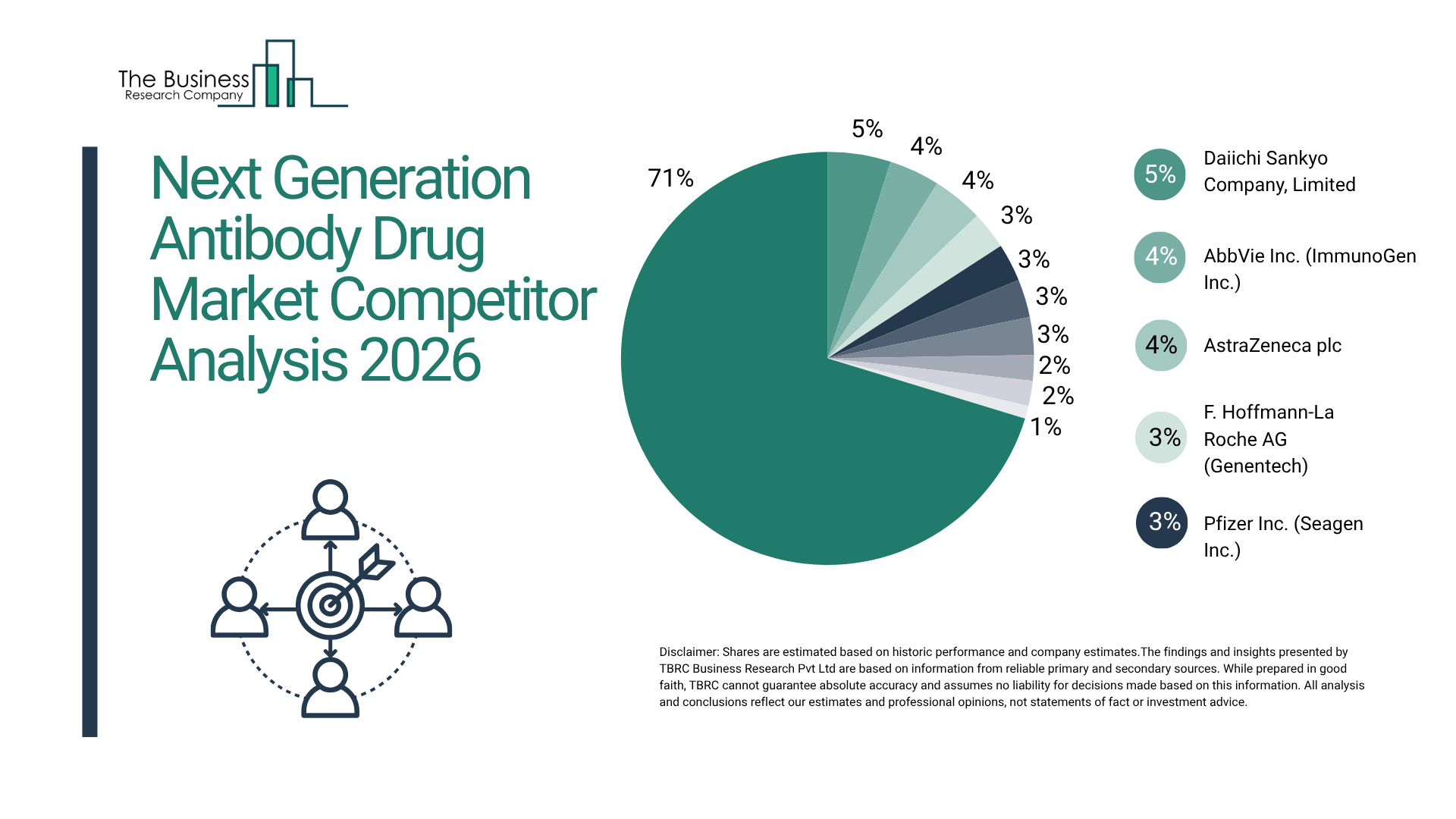
Daiichi Sankyo Company, Limited emerged as the top global player in 2025 with a 5% market share. Its oncology therapeutics division delivers a comprehensive range of antibody-drug conjugates, targeted biologics, and innovative antibody platforms that support precision oncology and next-generation cancer treatments, making it a key force in the market.
Major Competitors Shaping the Next Generation Antibody Drug Industry
Important companies competing in this market include Daiichi Sankyo Company, Limited, AbbVie Inc. (ImmunoGen Inc.), AstraZeneca plc, F. Hoffmann-La Roche AG (Genentech), Pfizer Inc. (Seagen Inc.), Boehringer Ingelheim International GmbH, Gilead Sciences Inc., Genmab A/S, Takeda Pharmaceutical Company Limited, Kyowa Hakko Kirin Co. Ltd., ADC Therapeutics, Akeso Inc., Astellas Pharma Inc., Xencor Inc., GlaxoSmithKline (GSK), Mablink Bioscience, Synaffix, Araris Biotech, Rakuten Medical, Zai Lab Ltd., and Mersana Therapeutics.
Moderate Market Fragmentation Reflects Barriers and Opportunities
The next generation antibody drug market is moderately fragmented, with the top 10 companies accounting for 29% of total revenues in 2025. Entry barriers stem from complex antibody engineering, rigorous clinical development requirements, advanced biologics manufacturing, and stringent regulatory standards. Leading firms maintain strong positions through diversified product portfolios, robust clinical pipelines, strategic collaborations, global commercialization, and continuous technological innovation. As demand for precision medicine and advanced therapies grows, partnerships and product innovation will remain critical for sustaining competitive advantages.
Primary Raw Material Suppliers Supporting Market Growth
Key suppliers of raw materials for the next generation antibody drug market include F. Hoffmann-La Roche Ltd., Amgen Inc., Pfizer Inc., Novartis AG, Merck and Co. Inc., Sanofi S.A., Bristol Myers Squibb Company, AstraZeneca plc, GlaxoSmithKline plc, Eli Lilly and Company, AbbVie Inc., Takeda Pharmaceutical Company Limited, Biogen Inc., Regeneron Pharmaceuticals Inc., Genmab A/S, Seagen Inc., Daiichi Sankyo Company Limited, Chugai Pharmaceutical Co. Ltd., ImmunoGen Inc., Xencor Inc., MacroGenics Inc., Sutro Biopharma Inc., Zymeworks Inc., Iovance Biotherapeutics Inc., and ADC Therapeutics SA.
Key Wholesalers and Distributors Facilitating Market Reach
Major wholesalers and distributors active in the next generation antibody drug market include McKesson Corporation, Cardinal Health Inc., Cencora Inc., AmerisourceBergen Distribution Services, Medipal Holdings Corporation, Owens and Minor Inc., Sinopharm Group Co. Ltd., Shanghai Pharmaceuticals Holding Co. Ltd., Phoenix Pharmahandel GmbH and Co KG, Zuellig Pharma Holdings Pte. Ltd., Walgreens Boots Alliance Distribution, Alliance Healthcare, Movianto GmbH, H. D. Smith Company Inc., Morris and Dickson Co. LLC, Anda Inc., Uniphar Group plc, Theramex Distribution Services, Nipro Corporation Distribution Services, Biocodex Distribution Network, Alloga Logistics Services, and Parata Systems Distribution Solutions.
Hospitals and Research Institutes as Key End Users
The primary end users of next generation antibody drugs include leading healthcare and research institutions such as Mayo Clinic, Cleveland Clinic, Johns Hopkins Hospital, Massachusetts General Hospital, Dana-Farber Cancer Institute, Memorial Sloan Kettering Cancer Center, University of California San Francisco Health, University of Oxford Hospitals NHS Foundation Trust, University College London Hospitals NHS Foundation Trust, Charité Universitätsmedizin Berlin, National Institutes of Health Clinical Center, St Jude Children’s Research Hospital, Labcorp Drug Development, Quest Diagnostics Incorporated, Apollo Hospitals Enterprise Limited, Fortis Healthcare Limited, Narayana Health, Medanta The Medicity, AIIMS New Delhi, Singapore General Hospital, National University Hospital Singapore, Tokyo University Hospital, Samsung Medical Center, and Sheba Medical Center.
Transformative Trends and Innovations in the Next Generation Antibody Drug Market
Antibody-drug conjugates (ADCs) are revolutionizing the market by enabling targeted cancer therapies that enhance treatment effectiveness while reducing systemic side effects. For example, in January 2024, BioNTech SE partnered with Duality Biologics and received FDA Fast Track designation for BNT325/DB-1305, aimed at treating platinum-resistant ovarian cancer. This DITAC platform combines a potent cytotoxic payload with a monoclonal antibody, providing precise tumor targeting that minimizes harm to healthy tissues and improves patient outcomes.
Strategies Companies Are Employing to Maintain Competitive Edge
Leading players in the next generation antibody drug market focus on advancing antibody engineering technologies to improve specificity and therapeutic efficacy. They are leveraging innovative drug design platforms to enhance precision medicine and safety profiles. Expansion of biomanufacturing capacities supports scalability and availability, while integrating bioprocessing technologies ensures high-quality control and operational efficiency. These approaches help sustain growth and innovation in this highly competitive field.
What’s new in our 2026 market reports:
• Market attractiveness scoring and analysis
• Total addressable market (TAM) analysis
• Company scoring matrix graphics and tables
• Excel dashboards
• Market hotspots infographics
• Key technologies and future trends
• Updated graphics and tables
Learn More About The Business Research Company
The Business Research Company (www.thebusinessresearchcompany.com) is a leading market intelligence firm renowned for its expertise in company, market, and consumer research. We have published over 30,000+ reports across 27 industries and 60+ geographies. Our research is powered by 1,500,000 datasets, extensive secondary research, and exclusive insights from interviews with industry leaders.
We provide continuous and custom research services, offering a range of specialized packages tailored to your needs, including Market Entry Research Package, Competitor Tracking Package, Supplier & Distributor Package and much more.
Disclaimer: Please note that the findings, conclusions and recommendations that TBRC Business Research Pvt Ltd delivers are based on information gathered in good faith from both primary and secondary sources, whose accuracy we are not always in a position to guarantee. As such TBRC Business Research Pvt Ltd can accept no liability whatever for actions taken based on any information that may subsequently prove to be incorrect. Analysis and findings included in TBRC reports and presentations are our estimates, opinions and are not intended as statements of fact or investment guidance.
Contact Us:
The Business Research Company
Americas +1 310-496-7795
Europe +44 7882 955267
Asia & Others +44 7882 955267 & +91 8897263534
Email: marketing@tbrc.info
Follow Us On:
LinkedIn: https://in.linkedin.com/company/the-business-research-company“
Oliver Guirdham
The Business Research Company
+44 7882 955267
info@tbrc.info
Visit us on social media:
LinkedIn
Facebook
X
Legal Disclaimer:
EIN Presswire provides this news content “as is” without warranty of any kind. We do not accept any responsibility or liability
for the accuracy, content, images, videos, licenses, completeness, legality, or reliability of the information contained in this
article. If you have any complaints or copyright issues related to this article, kindly contact the author above.

Media gallery